What residents could propose
Opt-in introductions, access to local advice, WhatsApp or other information channels, and invitations to meetings. Agree coverage and representation arrangements, with the option to form a separate RA as a group grows.
A real say should help people get things done. Residents have contributed these ideas for stronger neighbourhoods, better repairs and more opportunities for young people.
Starting points for discussion, not agreed council commitments or a fixed campaign programme. Residents should help choose priorities, costs and what success looks like.
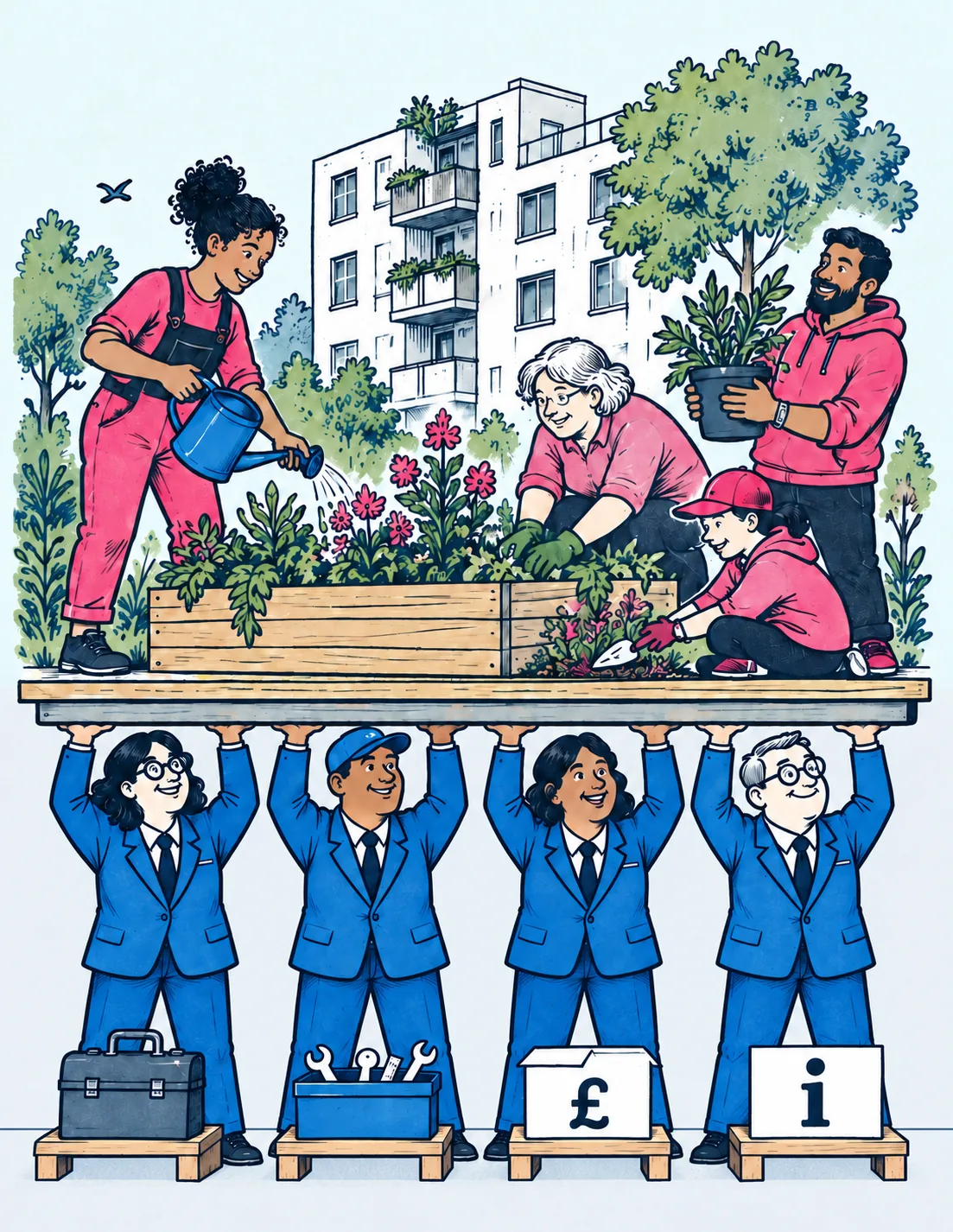
Starting an RA from scratch can be a big ask. Residents without an active association could be introduced to a nearby RA willing and able to help, with support from participation officers.
Opt-in introductions, access to local advice, WhatsApp or other information channels, and invitations to meetings. Agree coverage and representation arrangements, with the option to form a separate RA as a group grows.
Who will make introductions, what support existing volunteers will get and how residents can reach panels directly. Membership and formal representation need agreed rules; neither should be assumed.
How we check progress: are more previously disconnected residents getting help and influencing decisions? Ask whether the support is useful and manageable for the RAs involved.
No automatic transfer of names or contact details. Residents choose whether to be introduced or join a group. Direct participation stays open.
Reporting a repair should start a clear process, not leave residents chasing different teams for an update.
A joined-up repairs service accessed by phone, email and online. One reference, clear responsibility, appointment updates and a tracker showing the next step. Residents help design and test it, including people who do not use the internet.
How teams and contractors will share information, who owns unresolved jobs, what happens after a missed appointment and what the service will cost. Test the whole repair journey, not just a new website.
How we check progress: agree a baseline and acceptance criteria for repair times, missed appointments, repeat visits, unresolved work and residents’ experience. Publish grouped results and let resident scrutiny identify recurring failures.
A resident proposal. This page does not claim a particular technology supplier or a delivery date has been agreed.
Connect schools, youth centres, sports clubs, charities and local amenities. Ask young people what they need, support them to take part and give them influence over the choices.
Estate-based youth outreach, including exploring a mobile service; football and other sports; tutoring and youth clubs; and placements or internships supported through council contractors’ social value commitments. Affordable access matters as much as the activity itself.
What already exists, where the gaps are and which partners could help. Explain funding, eligibility, travel barriers and how opportunities will reach young people across estates. Ask participants what should be kept, changed or tried.
How we check progress: who is reached, who returns, who is missing and whether cost or travel still prevents participation. Ask young people what they gained and show which decisions their views changed.
The council announced the end of the Youth Bus service in July 2026. Exploring mobile outreach is a proposal to discuss, not an existing offer.
The housing strategy lists Chelsea Kicks. Current sessions and availability should be checked with providers.
Rackets Cubed combines racket sports, STEM education and meals. Its local community work includes support in Roehampton and Battersea. These are examples of partnerships to learn from, not promises of places or council funding.
The council announced a replacement for Access for All. Any proposal for wider discounts needs clear costs and eligibility.
Ombudsman evidence repeatedly points to delays, poor communication, unclear responsibility and weak records. These are areas residents could prioritise, not a claim that every estate has the same problems. Each example below connects a service issue to resident oversight.
Propose: clear block-level cleaning standards, schedules and a simple way to report missed work. Let residents help check delivery without becoming unpaid contract managers.
Council answer: who checks contractors, how failures are put right and how charged services relate to work delivered.
Check: repeat failures, time to remedy and residents’ assessment of cleanliness. A Wandsworth cleaning complaint illustrates reporting and contractor follow-through problems; it is one case, not a borough-wide measure.
Propose: accessible block-level safety updates, named responsibility and clear routes to raise concerns about communal areas, doors and overdue work.
Council answer: what actions are outstanding, how risks are prioritised and what evidence confirms completion.
Check: overdue actions and verified completion, alongside residents’ understanding of information. The council’s inspection account describes electrical and fire-safety shortcomings at the time of inspection. Those historical figures are not today’s position. Resident scrutiny supports, but does not replace, professional safety duties.
Propose: early discussion of scope and options, understandable estimates, explanations of changes and evidence of work quality. Make payment support and independent advice easy to find.
Council answer: why work is needed, the basis for charges, alternatives considered and how residents’ observations affected decisions.
Check: estimate-to-final-cost changes, defects, response times and access to supporting records. The council already promises resident involvement in major works. A Wandsworth service-charge information case shows why records matter.
Cost-of-living support should connect housing teams with benefits, debt and energy advice. Payment arrangements can help, but do not settle whether a bill is correct.
Propose: clear explanations of who is responsible under the relevant lease, joined-up handling of alleged landlord failures and access to independent advice.
Council answer: which obligation applies, what evidence it has considered and how a disputed response can be challenged.
Check: repeat disputes, time to resolve and lessons applied across blocks. The Ombudsman’s leaseholder learning identifies recurring confusion about obligations. A complaint is not itself proof of a lease breach. Keep individual complaints and appropriate legal routes open alongside collective scrutiny.
Propose: investigate underlying causes, connect repairs and housing teams, and check with residents after work rather than closing jobs solely on contractor records.
Council answer: who owns the whole case and how repeated reports trigger further investigation.
Check: recurrence, time to lasting resolution and residents’ confirmation of improvement. The Ombudsman’s damp and mould and repairs reports provide sector learning.
Propose: coordinated responses across housing, repairs and relevant partners, with clear ownership and updates.
Council answer: whether the cause is behaviour, building condition or both, and what response fits the evidence.
Check: repeat reports, response times and whether residents experience improvement. The Ombudsman’s noise investigation warns against treating ordinary household noise as ASB automatically.
Propose: working standards for contractors on estates: notice to residents, a named site contact, clearing up, and no damage to original features. Record a building’s condition before work starts and ask residents to confirm completion. Involve residents in setting service specifications before contracts are tendered or renewed, and widen the pool of firms able to bid so quality counts, not just accreditation.
Council answer: who holds which contracts and when they are renewed, which accreditation and framework rules limit who can bid, how damage and poor work are put right and at whose cost, and whether past performance affects future awards. Questions referred to procurement need a named owner and a date for an answer.
Check: damage reported and repaired, repeat failures by contractor, residents’ sign-off on completed work and whether resident priorities appear in new specifications. Procurement rules limit what can be shared during a live tender, so the aim is earlier involvement and real consequences for poor work, not access to confidential bids.
Propose: the council takes responsibility for what estates have already lost. Investigate thefts and damage, report them to the police and insurers, and restore or replace what has gone: commemorative plaques, tiling, brass fittings, signage and joinery. Use the council’s own building records, archive photographs and original drawings so restoration does not depend on residents’ memories. Protect what remains as part of routine estate management.
Council answer: what record it holds of each estate’s original features, whether they were insured, why losses were not recorded or claimed, and who decides on restoration and funding.
Check: losses recorded and investigated, insurance claims made, features restored or replaced, and damage recovered from contractors responsible. Residents who want to can share photographs and history, but keeping the record is the council’s job.
Residents report fittings stripped from estates across the borough, down to brass taps, and original tiling damaged beyond repair during works. In one case a bronze plaque commemorating a building’s opening was stolen, and the council had no record of it.
Propose: help residents use formal complaints with confidence. A formal complaint is the route to independent review by the Housing Ombudsman. When a problem affects many households in the same way, residents can complain together: one affected resident acts as lead complainant, other households sign to authorise them, and an RA or residents’ group can organise and gather evidence.
Council answer: complaint themes by estate, service and contractor, how repeat complaints trigger action on the underlying cause, and how complaints affect contract management.
Check: complaints answered on time, repeat complaints, Ombudsman findings and lessons applied. The council’s housing complaints policy sets 10 working days for a Stage 1 response and 20 for Stage 2. Under its group complaints guidance, the Ombudsman decides whether to treat a case as a group complaint and only does so when the facts are the same for everyone. Individual complaints stay open alongside.
Residents choose which issues need collective scrutiny. Formal complaints are a right worth using, individually or together. The council still has to deliver services and deal with individual concerns, whether people attend meetings or not.
Residents identify a need. Together we agree acceptance criteria and consider options. The council gives an answer with reasons, resources, a named owner and timescales. Residents check progress and help change what is not working.
This is a fair value exchange: local knowledge and effort met with practical backing and influence. Good services remain the council’s responsibility whether people participate or not.